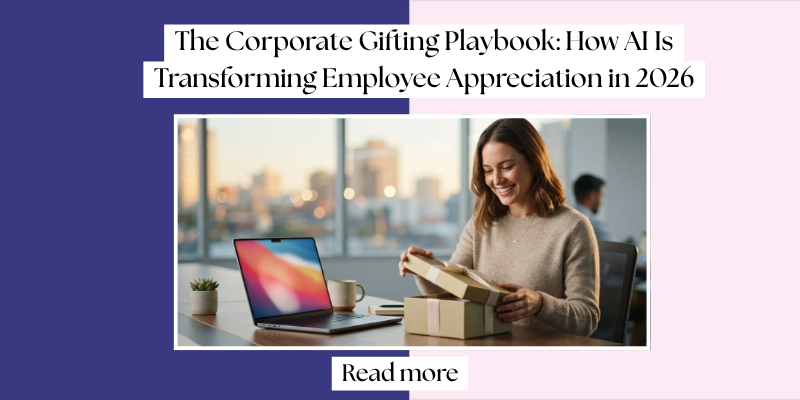
Walk into almost any office and you’ll find them: drawers full of branded water bottles, unopened company-logo hoodies, and mugs nobody asked for. Corporate gifting has a scale problem and a personalization problem happening at the same time, and most companies are quietly losing the return on investment they could be getting from one of their most powerful retention and loyalty tools.
The numbers make the stakes clear. Corporate gifting represents a $925 billion global industry, yet the sophistication of most gifting programs hasn’t kept pace with the size of the opportunity. That gap is exactly where AI-powered gifting platforms are stepping in.
The Three Problems Every Corporate Gifting Program Faces
Ask any HR leader or office manager about gifting, and three recurring pain points come up:
- Scale. Sending a meaningful gift to five people is easy. Sending one to five hundred employees or a thousand clients is a logistical nightmare.
- Personalization at volume. The default fallback, the same branded item for everyone, solves the scale problem but creates the “everyone gets the same mug” effect, which reads as impersonal no matter how nice the mug is.
- Measuring ROI. Without data on what worked, gifting spend becomes a recurring cost nobody can justify or improve year over year.
Traditional gifting vendors solve maybe one of these three problems. AI-powered platforms are built to solve all three simultaneously, by building individual recipient profiles, matching gifts to those profiles automatically, and tracking outcomes across the whole program.
Why Personalization Matters Even in a Professional Context
It’s tempting to assume that gifting psychology only applies to birthdays and holidays among family and friends. The research says otherwise. Personalized gifts have been shown to enhance emotional intimacy and connection between giver and receiver, a dynamic that holds up even in professional relationships, not just personal ones.
There’s a specific mechanism at work here. University of Bath research on personalized gifting found that when a recipient recognizes a gift was chosen specifically for them, they experience what researchers term “vicarious pride,” a boost in self-esteem tied directly to feeling individually seen. In an employee appreciation context, this translates into something concrete: organizational belonging. When an employee opens a gift that clearly reflects their interests, such as a gardening kit for the team member who talks about their garden, or a specialty coffee subscription for the office’s known coffee enthusiast, the underlying message lands clearly: this organization sees me as a person, not a headcount number.
That message is difficult to send with a generic branded item, no matter how well-designed the branding is.
The AI Advantage at Scale
This is where AI-powered gifting genuinely changes the math. Instead of choosing one item for an entire department, an AI system can:
- Build individual recipient profiles based on stated interests, role, or past preferences
- Automatically match each profile against a curated catalog, so five hundred employees can receive five hundred different, individually relevant gifts
- Operate at speed, compressing what would traditionally take a team days of manual selection and coordination into a fraction of the time
- Track outcomes, giving HR and procurement teams actual data on engagement and satisfaction rather than guesswork
Consider what this looks like in practice: a mid-sized company needing to send holiday gifts to 200 employees can build profiles and generate personalized matches for the entire group in about the time it would take to manually research gifts for a handful of people the old-fashioned way.
Building the ROI Case
Corporate gifting has historically been hard to justify on a spreadsheet, because “goodwill” doesn’t show up as a clean metric. But personalized, AI-matched gifting creates a more defensible ROI framework across three dimensions:
- Employee retention. Feeling individually valued is a documented driver of organizational belonging and loyalty.
- Client loyalty. Personalized client gifts signal genuine relationship investment, not transactional obligation.
- Brand perception. Thoughtful gifting reflects on company culture in ways generic swag simply doesn’t.
None of these are hypothetical benefits, they’re the direct downstream effect of the psychological research on personalization translating into a business context.
Getting Started With AI-Powered Corporate Gifting
Most B2B gifting platforms today still operate the old way: browse a catalog, pick one item, ship it to everyone. The shift to AI-matched corporate gifting doesn’t require overhauling your entire program. It typically starts with a single use case, like a holiday appreciation round or a new-hire welcome gift, where you can build profiles for a defined group and measure the response before scaling further.
The companies that get ahead of this shift aren’t just saving time on gift selection, they’re turning a line-item expense into a genuine engagement and retention tool.
The Bottom Line
Corporate gifting is a massive, largely underdeveloped market. The organizations still relying on one-size-fits-all swag are leaving real value on the table, both in terms of employee sentiment and measurable business outcomes. AI-powered personalization doesn’t just make corporate gifting faster, it makes it actually work the way gifting is supposed to work: like the organization sees the individual behind the role.
Frequently Asked Questions
How is AI corporate gifting different from a traditional gifting vendor?
Traditional vendors typically offer a catalog you select from manually, often landing on one item for a whole group. AI-powered platforms build individual recipient profiles and automatically match personalized gifts at scale, without requiring manual selection for each person.
Does personalized gifting actually improve employee retention?
Research on gift psychology shows that personalized gifts create a documented boost in feeling individually valued, which is a recognized driver of organizational belonging, a key factor in retention, though it should be considered one input among many in a broader retention strategy.
Is AI corporate gifting more expensive than traditional branded swag?
Costs vary by platform and gift tier, but many companies find that reduced administrative time (sourcing, ordering, tracking) offsets or outweighs any premium, especially at scale.
Can AI gifting handle both employees and clients?
Yes. Most AI-powered platforms are built to support both use cases, since the underlying approach of building a profile and matching relevant gifts works whether the recipient is internal or external to the company.
How quickly can a company set up an AI-powered gifting program?
Implementation timelines vary by provider and program size, but many platforms are designed to launch a first campaign, such as a holiday round or new-hire gifting, within a matter of days rather than weeks.
Leave a Reply